
Weekly Grammar Worksheet: Apostrophes Answer Key – Mastering Possession and Contraction
Apostrophes are small but mighty punctuation marks that often cause confusion. They primarily serve two vital roles in English grammar: indicating possession and forming contractions. Understanding how to use them correctly is crucial for clear and effective writing. This guide provides an overview of a typical “Weekly Grammar Worksheet: Apostrophes Answer Key,” breaking down the common rules and addressing potential pitfalls.
Possessive Apostrophes: Showing Ownership
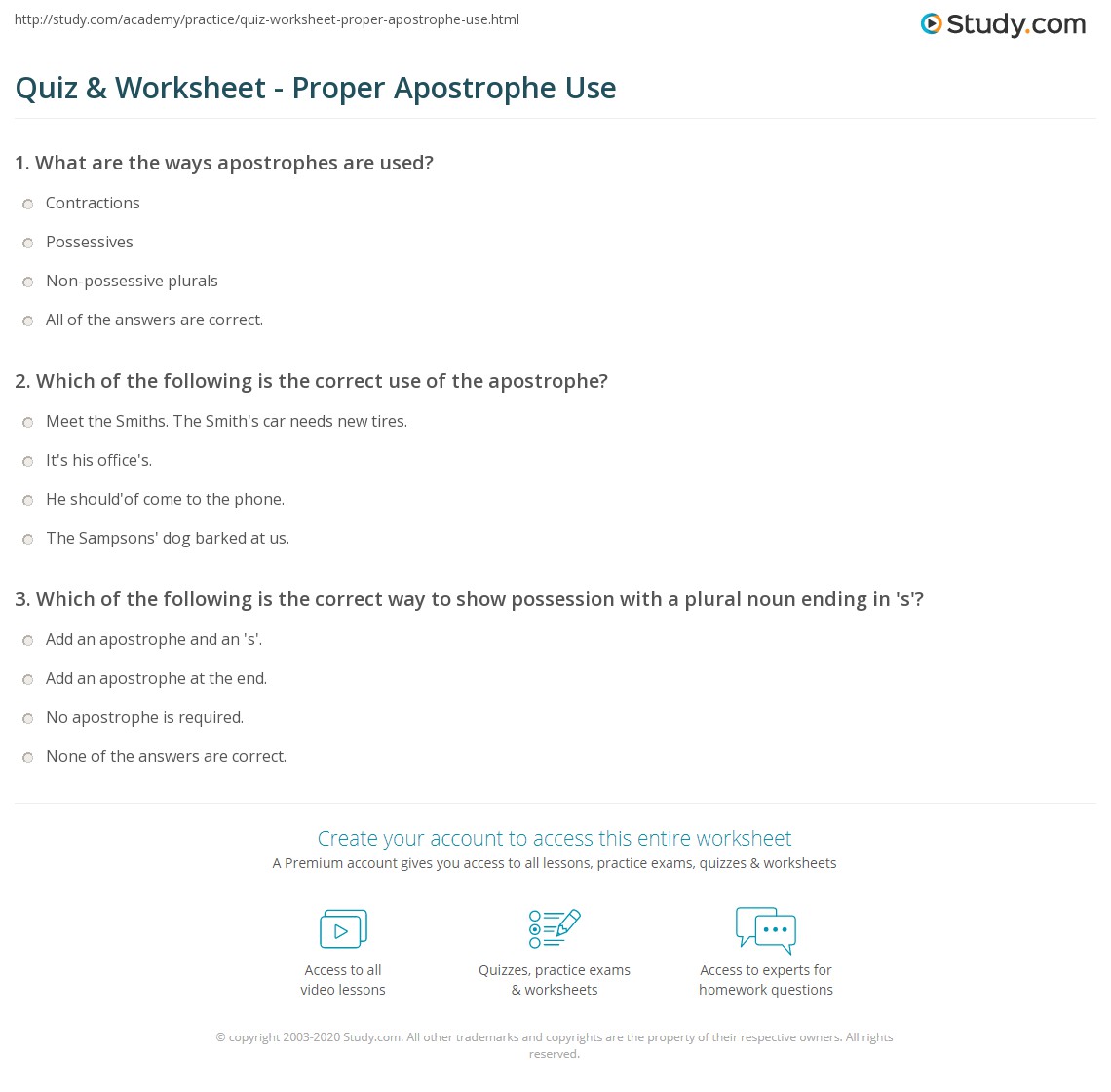
The most frequent use of apostrophes is to show that something belongs to someone or something else. The basic rule is simple: add an apostrophe and an ‘s’ (‘s) to singular nouns and indefinite pronouns.
Example: The dog’s bone. (The bone belongs to the dog.)
Example: Someone’s keys were left on the table. (The keys belong to someone.)
For plural nouns that already end in ‘s’, you simply add an apostrophe after the ‘s’.
Example: The students’ desks. (The desks belong to the students.)
However, for plural nouns that *don’t* end in ‘s’ (irregular plurals), you add an apostrophe and an ‘s’ (‘s), just like with singular nouns.
Example: The children’s toys. (The toys belong to the children.)
Example: The men’s restroom. (The restroom is for men.)
When showing joint possession (ownership by multiple entities), you only need to add the apostrophe (and ‘s’ if applicable) to the last noun in the list. If they own separate things, each noun needs the possessive apostrophe.
Example (joint): John and Mary’s house. (John and Mary share one house.)
Example (separate): John’s and Mary’s cars. (John and Mary each have their own car.)
Contractions: Combining Words
Apostrophes are also used to create contractions, which combine two words into one, omitting letters. The apostrophe marks the place where letters have been removed.
Common Contractions:
- is not = isn’t
- cannot = can’t
- will not = won’t
- I am = I’m
- you are = you’re
- they are = they’re
- it is = it’s
- would have = would’ve
A frequent error involves confusing “its” (possessive) with “it’s” (contraction of “it is” or “it has”). “Its” shows possession without an apostrophe, while “it’s” always indicates a contraction.
Example: The dog wagged its tail. (Possessive)
Example: It’s a beautiful day. (Contraction of “It is”)
Common Mistakes and Troubleshooting
Many apostrophe errors stem from a misunderstanding of the possessive form or confusing contractions with possessive pronouns (like its/it’s, your/you’re, their/there/they’re). Carefully consider whether you need to show possession or are combining words.
Worksheet answer keys often include sentences designed to highlight these common mistakes. By practicing with these worksheets and carefully reviewing the answer key, you can drastically improve your apostrophe usage and write with greater confidence and accuracy.
 298×386 weekly grammar worksheet apostrophes answer key fill printable fillable blank from www.pdffiller.com
  2480×3508 weekly grammar worksheet apostrophes answer key printable word searches from davida.davivienda.com
  500×707 weekly grammar worksheet apostrophes answer key prntblconcejomunicipaldechinugovco from prntbl.concejomunicipaldechinu.gov.co
  612×792 weekly grammar worksheet apostrophes answer key from materialstephenson99.s3-website-us-east-1.amazonaws.com
  181×233 jaeanalyn buan apostrophe worksheet pg jpg weekly grammar worksheets library from worksheets.clipart-library.com
  344×500 apostrophes speech marks grammar worksheets answers tpt worksheets library from worksheets.clipart-library.com
  1000×750 apostrophes worksheet apostrophes worksheet png images worksheets from worksheets.clipart-library.com
  453×640 apostrophes worksheet from www.slideshare.net
453×640 apostrophes worksheet from www.slideshare.net  1000×1291 apostrophes possession worksheet worksheets worksheets library from worksheets.clipart-library.com
  1589×2249 weekly grammar worksheet commas from legacy.cloudshark.org
  736×953 master apostrophes weekly grammar worksheet answer key included from studyfinder.org
  298×386 fillable weekly grammar worksheet apostrophes answer key fill fax email from www.pdffiller.com
  1140×1121 weekly grammar worksheet apostrophes from ravens.nckl.gov.kh
  180×234 improve grammar skills weekly apostrophe worksheets hero from www.coursehero.com
  270×350 apostrophes rules review worksheet detailed answer key from www.teacherspayteachers.com
  1000×1776 apostrophes interactive activity worksheets worksheets library from worksheets.clipart-library.com
  1224×1584 weekly grammar worksheet apostrophes grammar practice sheets apostrophes quotation marks from terencepix.blogspot.com